
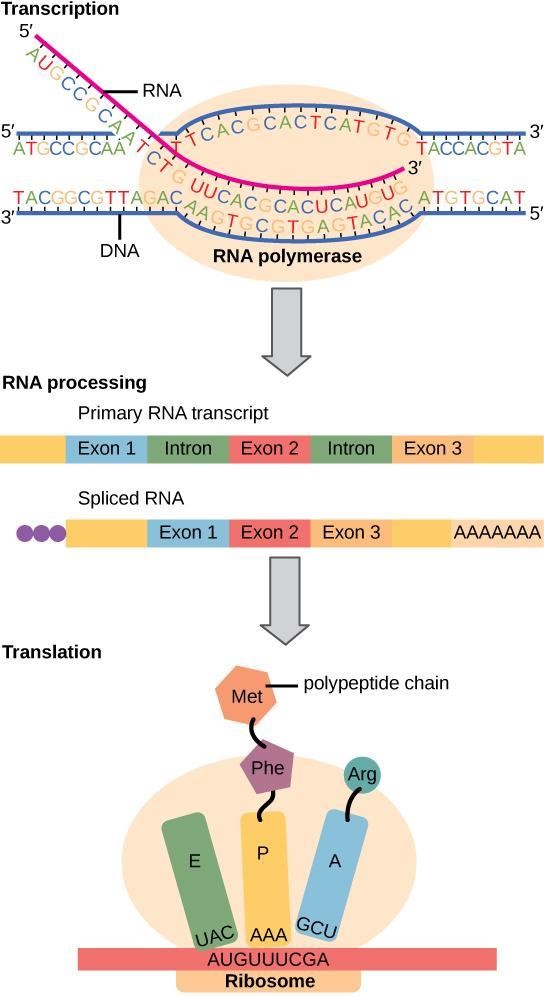
What Template Molecule Does The Process Of Translation Start With - Transcription is initiated by the attachment of a protein known as a sigma. Translation begins when an initiator trna anticodon recognizes a codon on mrna. The small subunit is responsible for binding the mrna template, whereas the large subunit sequentially binds trnas, a type of rna molecule that brings amino acids to the growing chain of the polypeptide. The sigma attaches to one strand of the dna (the template strand) at a very specific location. The large ribosomal subunit joins the small subunit,. The process of translation, or protein synthesis, the second part of gene expression, involves the decoding by a ribosome of an mrna message. The players in translation include the mrna template, ribosomes, trnas, and various enzymatic factors. In bacteria, several sigmas exists and each one initiates the transcription of a specific sequence of dna (or gene).

Transcription And Translation Diagram Labeled
The players in translation include the mrna template, ribosomes, trnas, and various enzymatic factors. The process of translation, or protein synthesis, the second part of gene expression, involves the decoding by a ribosome of an mrna message. Translation begins when an initiator trna anticodon recognizes a codon on mrna. The large ribosomal subunit joins the small subunit,. The small subunit.

Lecture 89 Preview
The sigma attaches to one strand of the dna (the template strand) at a very specific location. The small subunit is responsible for binding the mrna template, whereas the large subunit sequentially binds trnas, a type of rna molecule that brings amino acids to the growing chain of the polypeptide. The players in translation include the mrna template, ribosomes, trnas,.

PPT Protein SynthesisTranslation PowerPoint Presentation, free download ID5738318
The players in translation include the mrna template, ribosomes, trnas, and various enzymatic factors. Translation begins when an initiator trna anticodon recognizes a codon on mrna. The process of translation, or protein synthesis, the second part of gene expression, involves the decoding by a ribosome of an mrna message. The sigma attaches to one strand of the dna (the template.

PPT Translation PowerPoint Presentation, free download ID526266
The process of translation, or protein synthesis, the second part of gene expression, involves the decoding by a ribosome of an mrna message. The small subunit is responsible for binding the mrna template, whereas the large subunit sequentially binds trnas, a type of rna molecule that brings amino acids to the growing chain of the polypeptide. Translation begins when an.

and Translation Owlcation
The process of translation, or protein synthesis, the second part of gene expression, involves the decoding by a ribosome of an mrna message. Translation begins when an initiator trna anticodon recognizes a codon on mrna. Transcription is initiated by the attachment of a protein known as a sigma. The sigma attaches to one strand of the dna (the template strand).
“Chapter 4 Translation” in “Fundamentals of Cell Biology” on OpenALG
In bacteria, several sigmas exists and each one initiates the transcription of a specific sequence of dna (or gene). Transcription is initiated by the attachment of a protein known as a sigma. Translation begins when an initiator trna anticodon recognizes a codon on mrna. The sigma attaches to one strand of the dna (the template strand) at a very specific.

Prokaryotic Translation with Enzymes, Sites, Steps
The small subunit is responsible for binding the mrna template, whereas the large subunit sequentially binds trnas, a type of rna molecule that brings amino acids to the growing chain of the polypeptide. In bacteria, several sigmas exists and each one initiates the transcription of a specific sequence of dna (or gene). Translation begins when an initiator trna anticodon recognizes.

4.3 Transcription and Translation
The process of translation, or protein synthesis, the second part of gene expression, involves the decoding by a ribosome of an mrna message. The sigma attaches to one strand of the dna (the template strand) at a very specific location. Transcription is initiated by the attachment of a protein known as a sigma. The players in translation include the mrna.

DNA Transcription Explained ChemTalk
Translation begins when an initiator trna anticodon recognizes a codon on mrna. The large ribosomal subunit joins the small subunit,. The small subunit is responsible for binding the mrna template, whereas the large subunit sequentially binds trnas, a type of rna molecule that brings amino acids to the growing chain of the polypeptide. The process of translation, or protein synthesis,.

Dna Transcription And Translation Flowchart
The large ribosomal subunit joins the small subunit,. The players in translation include the mrna template, ribosomes, trnas, and various enzymatic factors. Transcription is initiated by the attachment of a protein known as a sigma. Translation begins when an initiator trna anticodon recognizes a codon on mrna. The small subunit is responsible for binding the mrna template, whereas the large.
Transcription is initiated by the attachment of a protein known as a sigma. Translation begins when an initiator trna anticodon recognizes a codon on mrna. The sigma attaches to one strand of the dna (the template strand) at a very specific location. The process of translation, or protein synthesis, the second part of gene expression, involves the decoding by a ribosome of an mrna message. In bacteria, several sigmas exists and each one initiates the transcription of a specific sequence of dna (or gene). The small subunit is responsible for binding the mrna template, whereas the large subunit sequentially binds trnas, a type of rna molecule that brings amino acids to the growing chain of the polypeptide. The players in translation include the mrna template, ribosomes, trnas, and various enzymatic factors. The large ribosomal subunit joins the small subunit,.
Transcription Is Initiated By The Attachment Of A Protein Known As A Sigma.
The sigma attaches to one strand of the dna (the template strand) at a very specific location. In bacteria, several sigmas exists and each one initiates the transcription of a specific sequence of dna (or gene). The players in translation include the mrna template, ribosomes, trnas, and various enzymatic factors. Translation begins when an initiator trna anticodon recognizes a codon on mrna.
The Small Subunit Is Responsible For Binding The Mrna Template, Whereas The Large Subunit Sequentially Binds Trnas, A Type Of Rna Molecule That Brings Amino Acids To The Growing Chain Of The Polypeptide.
The large ribosomal subunit joins the small subunit,. The process of translation, or protein synthesis, the second part of gene expression, involves the decoding by a ribosome of an mrna message.